
Automatic Gate Automation vs Automatic Bollards: Which Is Better for Your Site?

Choosing between automatic gate automation and automatic bollards depends on what the entrance needs to achieve.
Both systems control vehicle access. Both can connect with intercoms, keypads, fobs, ANPR and wider access control systems. The difference is how they manage the boundary, the available space and the movement of people around the site.
Gates create a controlled entrance. Bollards control vehicles while keeping the frontage open.
This guide explains the practical differences for commercial car parks, depots, residential developments and private homes.
Start With The Site, Not The Product
The right solution begins with the layout and the way the entrance is used.
Consider:
- How many vehicles use the entrance each day?
- Do pedestrians need to pass through the same point?
- Is there enough room for a swing or sliding gate?
- Does the site need privacy or a visible security boundary?
- Are deliveries, visitors or emergency vehicles expected?
- Is the system being installed near a public highway?
- Does an existing intercom, CCTV or access control system need to be retained?
A site survey helps answer these questions before equipment is selected. It also identifies ground conditions, power routes, drainage, vehicle visibility and potential safety risks.
Automatic Gates Create A Complete Boundary
Automatic gates are suited to entrances where the whole opening needs to be secured.
A gate can control both vehicles and pedestrians. It can also form part of a wider perimeter with fencing, walls or security metalwork. This makes automatic gate automation a practical choice for commercial yards, depots, private drives and residential developments.
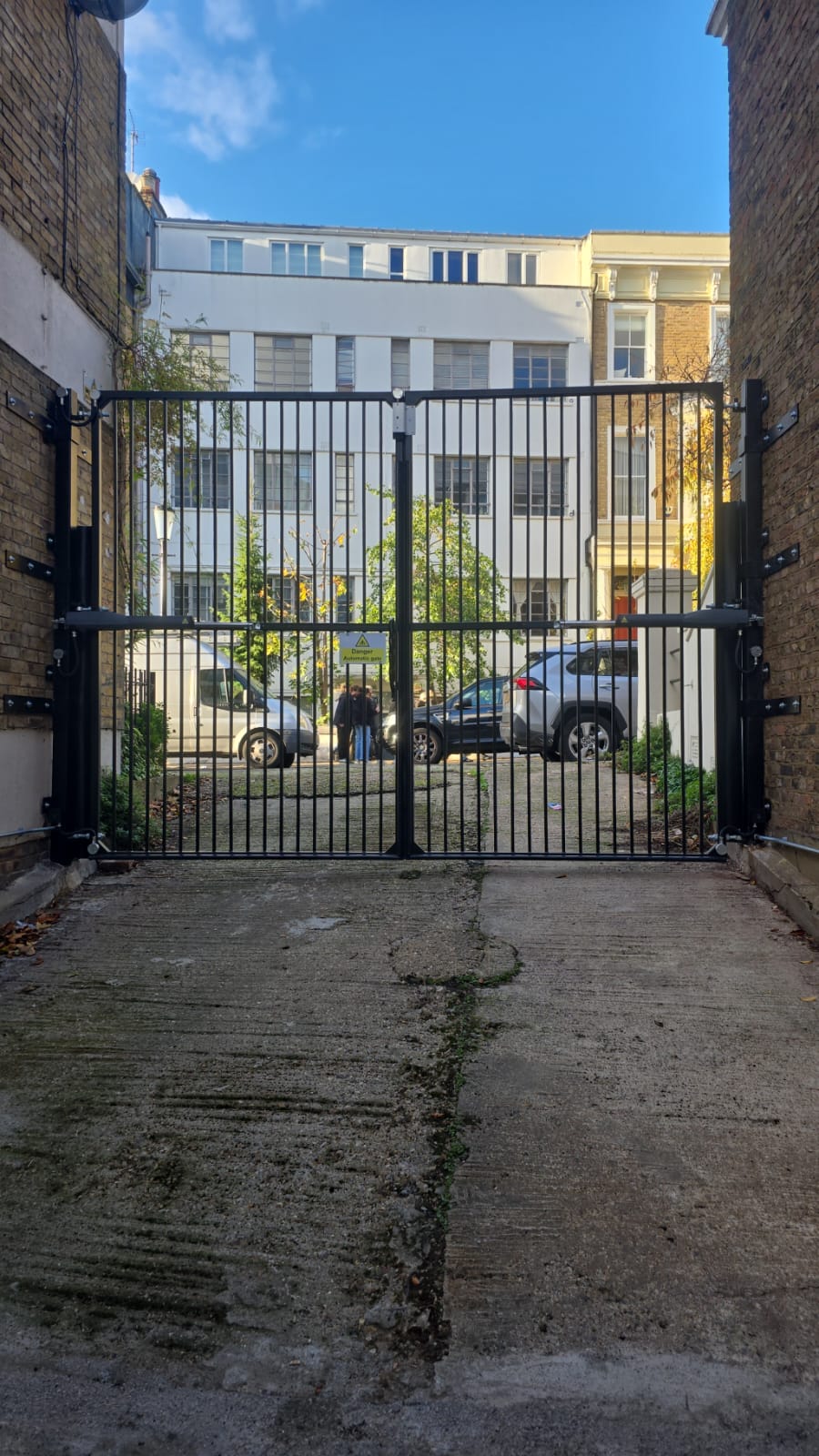
Where gates work well
Automatic gates are commonly considered for:
- Commercial yards and depots
- Private car parks
- Residential developments
- School and education sites
- Service entrances
- Private driveways
- Secure compounds and storage areas
A sliding gate is often suitable where there is space alongside the entrance but limited room for a gate leaf to swing. Swing gates can work well where there is clear space inside the site and the opening is straightforward.
Bi-folding gates may be considered where opening speed and restricted side space are important. The correct arrangement depends on the entrance width, ground conditions, frequency of use and required operating speed.
Gates support stronger separation
A gate makes the boundary clear. When closed, it separates the public side from the controlled side of the property.
That can help with:
- Site security
- Privacy
- Vehicle management
- Pedestrian control
- Restricted delivery areas
- Protection of equipment and stored materials
A gate does not replace good site design or other security measures. However, it can provide a clear first point of control when combined with suitable fencing, lighting, CCTV and access control.
For further background on gate types and automation options, the Jacksons gate automation guide provides a useful overview of swing, sliding and bi-folding systems.
Automatic Bollards Keep The Entrance Open
Automatic bollards are retractable posts installed into the ground. When raised, they restrict vehicle access. When lowered, they allow authorised vehicles to pass.
Unlike a full gate, bollards do not usually create a complete pedestrian barrier. People can often move around them, subject to the site layout and any additional fencing or protection.
This makes automatic bollards installation suitable where vehicle control is required but an open frontage is preferred.
Where bollards work well
Automatic bollards may be appropriate for:
- Car park entrances
- Courtyards and shared spaces
- Office parks
- Retail and commercial frontages
- Service roads
- Loading and delivery zones
- Controlled vehicle areas within larger sites
- Private drives where a full gate is not required
Bollards can be useful where a gate would take up too much space or create an unwanted visual barrier. They are also practical where pedestrians, cyclists and vehicles need to use the same general area.
A specialist automatic bollards installation service can advise on the number, spacing, foundation requirements and control method for a particular entrance.
Space And Planning Need Early Attention
The available space is one of the clearest differences between gates and bollards.
Gate space requirements
Swing gates need room to open. That space must remain clear of parked vehicles, walls, pedestrian routes and other obstructions.
Sliding gates need a suitable run along the boundary. A cantilever arrangement may help where a ground track is not suitable, but it still requires sufficient room for the gate to move.
The entrance also needs enough space for vehicles to stop safely while the gate opens. This is especially important where the entrance connects directly to a public road.
Bollard space requirements
Bollards use less visible space when lowered, but they still require substantial below-ground work. The installation may involve excavation, foundations, drainage, power and control cabling.
Underground services must be considered before excavation. The position of the bollards must also be coordinated with:
- Vehicle turning areas
- Pedestrian walkways
- Cycle routes
- Drainage
- Delivery movements
- Visibility for drivers
- Emergency access
Planning requirements vary by location and project. If the entrance is close to a public highway, in a shared area or within a sensitive planning environment, confirm the position with the relevant local authority before work begins.
Safety Is Part Of The Design
Automation should never be treated as an add-on.
Automatic gates need suitable safety measures, including photocells, safety edges, obstacle detection, warning lights and appropriate controls. The system should be designed, installed, tested and maintained for the way it will actually be used.
The CAME gate automation range demonstrates how modern systems can include safety devices, remote management and access accessories. Product selection must remain specific to the gate, site and operating conditions.
Automatic bollards also require careful safety planning. Their movement must be visible and controlled. The design should account for vehicle detection, warning indicators, emergency access and safe operation during a power failure.
Both systems should include a suitable manual release or override arrangement where required. A maintenance plan is also important, particularly on commercial sites with frequent daily use.
Safe operation depends on correct design, installation, testing and ongoing inspection.
Both Options Integrate With Access Control
Automatic gates and bollards can use many of the same access methods.
These may include:
- Key fobs and remote transmitters
- Keypads
- Proximity cards
- GSM or mobile access
- Video and audio intercoms
- Smartphone applications
- ANPR
- Timed access schedules
- Reception or security control systems
For example, a visitor may use an intercom to contact reception. The operator can verify the request through video and release the gate or lower the bollards. Staff may use a fob, card or ANPR-recognised vehicle for routine access.

Integrating the entrance with the wider security system provides a clearer operating process. CCTV can record activity. Access control can manage permissions. Intercoms can support visitors and deliveries.
OneStop provides access control solutions, intercoms and door entry, CCTV and automated gate systems through one coordinated service.
Gates, Bollards Or Both?
There is no universal winner. The most suitable option depends on the access objective.
| Requirement | Automatic gates | Automatic bollards |
|---|---|---|
| Control vehicles | ✓ | ✓ |
| Control pedestrians | ✓ | Usually limited |
| Create a complete boundary | ✓ | No |
| Keep the frontage visually open | Limited | ✓ |
| Suit narrow or shared frontages | Sometimes | Often |
| Provide privacy | ✓ | No |
| Protect an open vehicle zone | Sometimes | ✓ |
| Integrate with intercoms and access control | ✓ | ✓ |
Choose automatic gates when:
- The entire entrance needs to be secured.
- Pedestrian and vehicle access must be controlled together.
- Privacy or perimeter protection is important.
- There is enough room for swing or sliding operation.
- The entrance forms part of a wider fenced or walled boundary.
Choose automatic bollards when:
- The main objective is to stop unauthorised vehicles.
- Pedestrian access should remain open.
- The site needs a lower visual impact.
- There is limited room for a gate.
- The entrance is part of a courtyard, shared space or open frontage.
Choose both when:
- The site has several different access points.
- A main perimeter gate controls the boundary.
- Bollards are needed inside the site to protect pedestrian areas or restricted zones.
- Different users require different levels of access.
- Vehicle management and perimeter security need to work together.
A Practical Recommendation
For a secure commercial compound or residential development, automatic gates are often the more complete entrance solution.
For an open car park, courtyard or controlled vehicle zone, automatic bollards may provide better access management with less visual obstruction.
For larger or more complex sites, a combined arrangement may deliver the clearest result. Gates can secure the perimeter while bollards manage internal vehicle routes, service areas and pedestrian-priority zones.
The next step is a site survey. It should review the entrance, traffic flow, pedestrian movement, ground conditions, power, safety requirements and integration with existing systems.
OneStop supports automated gates, security metalwork, access control, intercoms, CCTV and related entrance systems across the South East, with nationwide commercial coverage available.
Discuss the requirement with OneStop. A clear site assessment will show whether gates, automatic bollards or a complete integrated entrance solution is the right fit.